Search This Blog

Showing posts with label Serenity Prayer. Show all posts

Thursday, April 12, 2012

H.O.W. It Works

"We find that no one need have difficulty with the spirituality of the program. Willingness, honesty and open-mindedness are the essentials of recovery. But these are indispensable."
Alcoholics Anonymous (4th ed.), page 568
Referencing the above passage taken from the "Spiritual Experience" appendix to the 'Big Book' of Alcoholics Anonymous, the acronym "H.O.W." (as in "H.O.W. It Works") is often cited as representing the three qualities of mind that are necessary prerequisites for effectively working the AA program and, thus, attaining the spiritual awakening that allows the alcoholic addict to recover from "a seemingly hopeless state of mind and body."

Spirituality, with its ever-deepening understandings,  is by its nature a nuanced phenomenon. There are then, of necessity, both plain and more subtle aspects to all of its dimensions. There are both  conventional and extraordinary, mundane and subtle, layers to all spiritual teachings. To this end, it seems to me that there are both surface and deeper meaning to the requisite qualities of honesty, open-mindedness and willingness. And, of course, even beyond these meanings there are undoubtedly evermore deeper meanings to all three qualities, for in working the Twelve Steps, as in all spiritual practices, "more will be revealed."
Enter through the narrow gate. For wide is the gate and broad is the road that leads to destruction, and many enter through it. But small is the gate and narrow the road that leads to life, and only a few find it."
- Matthew 7:13-14
Honesty: At the conventional level, becoming honest means that we do no further harm to others by lying, covering up, taking what does not belong to us and being untruthful etc.. Often referred to as "cash register honesty," this level of truthfulness is necessary in order that we can make an admission of powerlessness over alcohol (and/or drugs) and move forward in working the Twelve Steps. It is particularly important as we undertake our moral inventory which is both a 'fact-finding' and 'fact-facing' exercise that is wholly dependent on the alcoholic addict's being honest about the facts of his or her life.

At a deeper level, however, the requisite honesty requires our facing the illusions and delusions that are at the core of our self-centeredness, or ego-centricity. (The ego, in the sense that it is used here and throughout A.A. literature does not mean 'pride, per se, but rather the false sense of 'self'' that is a construction of our ordinary, worldly consciousness.)

Derived from the Latin honestas, which originally designated a plant with semi-transparent seed pods, honesty means to be "free of deceit and untruthfulness" - in this instance, self-deceit. At page 55 in the 'Big Book,' we are assured that "the fundamental idea of God" is deep down within everyone - man, woman and child - but that it is "obscured" by the "calamity, pomp and worship of other things" that are characteristic of most people's ordinary thoughts - i.e., the thought patterns that are characteristic of the human ego, the thought patterns Bill W. called a "painful inner dialogue.". Thus, in this instance, to be honest is to be free from the self-deceit and inherent untruthfulness of our egoic and addictive thought patterns, the fearful thoughts and emotions which block us off from our true inner nature.

In becoming honest and recognizing the "ideas, emotions and attitudes" that habitually veil the divine or spiritual nature of our being, the curtains of "calamity, pomp and worship of other things" are at least temporarily or partially lifted and we can then see and sense the truth of what and who we are. In this sense, we can then truly become "a channel of His peace."

Indeed, in describing the nature of the "spiritual awakenings" that were known to relieve alcoholic addiction, Carl Jung (at page 27 of the 'Big Book') observed that:
"Ideas, emotions and attitudes which were once the guiding forces of the lives of these men are suddenly cast to one side, and a completely new set of conceptions and motives begin to dominate them."
 In this sense, one becomes honest with one's "self."

Open-Mindedness: There are, I have come to realize, at least two facets of being truly open-minded. In the simplest terms, to be open-minded is to be free from the prejudice and contempt we may feel for spiritual and/or religious matters. Most often arising from our skepticism towards religious doctrines or the resentments we hold towards religious institutions, such prejudices (i.e., pre-judgments) must be set aside. Indeed at page 87 in the 'Big Book' we are enjoined to "(be) quick to see where religious people are right."

(In this regard, I note that the very word 'religion' comes from the Latin phrase 're ligare,' which means "to rejoin" or "reunite." In this sense a "religious experience" - as discussed in the second paragraph of the Spiritual Experience appendix - is what reunites the suffering alcoholic addict with the totality of the world and all things, that is God.)

At a deeper level, to be open-minded is to have a clear mind that is free of compulsive thinking and old ideas. In the 'How It Works' reading (from page 55 in the 'Big Book') we are told that many of the early members of A.A. had "tried to hold onto (their) old ideas," but that "the result was nil until they let go absolutely." My experience is that "old ideas" are not only those that I held for years in respect of spiritual, religious and other matters, but they also consist of new ideas that I cannot easily get rid of - thoughts about people, circumstances, ideas and institutions - that occupy my mind unduly.

Like chewing gum, it does not take long for such 'new ideas' to grow old and lose their appeal once I have chewed and ruminated on them for any length of time. Thoughts that frighten me, anger me or provoke envy in me etc., can quickly overwhelm my consciousness, bolstering my ego and separating me from everyone and everything, thereby obscuring that "Great Reality" that exists deep down within (all of) us." Indeed, it is only through the practice of meditation and prayer that we are effectively enabled to rid ourselves of such thoughts, and so improve "our conscious contact" with the God of our own understanding, however we may understand that Being.

Willingness: The conventional meaning of 'willingness,' I believe, is merely the determination to take the steps that others have taken to attain and maintain their sobriety. To this end, the 'How It Works' reading specifically notes that "(i)f you want what we have and are willing to go to any lengths to get it, then you are ready to take certain steps." That includes admitting to one's self that you are alcoholic, to believe (or, at least, be willing to believe) that there is a Power greater than one's self which can restore you to sanity, making the decision to turn one's will and one's life over to the Power of the God of your understanding, and then proceeding with the moral inventory and amends making process laid out in the Twelve Steps. Those who are unwilling, are those who do not want what we have, and thus "are not ready" to work the Twelve Steps . . . at least yet. Their sobriety, if any, is typically tenuous, precarious and desperately uncomfortable. They are in real danger.

At a more fundamental level, an act of one's will is a decision to do something, in this instance to live life one's life on a spiritual basis. (At page 83 of the 'Big Book, we read: "The spiritual life is not a theory. We have to live it." Why? Because life is inherently spiritual. It was the late great spiritual teacher, Krishnamurti, who observed: "We are not human beings having a spiritual experience, but spiritual beings having a human experience.") And living one's life on a spiritual basis requires practice - a practice that starts with Step Three.

"Practicing Step Three," we read in the Twelve Steps and Twelve Traditions, "is like the opening of a door which to all appearances is still locked and closed. All we need is a key, and the decision to swing the door open. There is only one key, and it is called willingness." This, as above, signifies our decision to take the Twelve Steps in order to walk through that locked door and live a spiritual life.

"Once we have come into agreement with (the steps to be taken)," we read, "it is really easy to begin the practice of Step Three. In all times of emotional disturbance or indecision," (emphasis added), "we can pause, ask for quiet, and in the stillness simply say: God, grant me the serenity to accept the things I cannot change, courage to change the things I can, and wisdom to know the difference. Thy will, not mine, be done."

The serenity, courage and wisdom we ask for are only truly available to us when we effect (or re-effect) a conscious contact with the God of our understanding; that is, when we are released from our ordinary ego-consciousnesss, and thus attain our higher God-consciousness. (The human ego is, by its nature, troubled, frightened and lost, the very antithesis to the serenity, courage and wisdom of higher consciousness.) Dissecting the power of this Serenity Prayer, we can observe that:
  • 'Serenity' is the nature of our Being when we shed ordinary, self-consciousness/ego-consciousness and effect a conscious contact with our higher nature - i.e., with God.
  • 'Courage' (from the Latin 'cour,' meaning heart) is to change the only thing we can in any instance - that is, to deepen the level of our consciousness. Symbolically it is to shift the center of our consciousness and thinking from the head/ego and its "painful inner dialogue," to the heart/soul (or deeper seat of consciousness) wherein there is a total acceptance of people, circumstances and the world exactly as they are in this instant of time.
  • 'Wisdom' is to know, from experience, that there are two wholly different realities within us. One is the ego - i.e., the 'self' or 'self-consciousness - which lies at the root cause of our alcoholic addiction, the reality which we sought to escape from through the use of alcohol and/or drugs. The other is our authentic Being, wherein we are wholly at one (i.e., in communion) with God.
In his last public talk, Dr. Bob pointed to the "absolute necessity" of the teachings that he and Bill W. derived from the Beatitudes, First Corinthians 13, and the Book of James. A close reading of the latter identifies the problem of not just alcoholic addicts, but of all men and women: 

"A double-minded man is unstable in all his ways." (James 1:8)
  • So long as we respond to life and act on the basis of our egoic, rather than God-conscious, thinking. We are apt to think, say and do almost anything. Our old ego-centric thinking and ideas will always be prone to lead us back into active addiction. Thus, we must be willing to work the Twelve Steps in order to deflate the ego "at depth." Nothing changes - "the result is nil" - unless we let go of our old ideas and our habitual ego-consciousness.
 "Draw near to God, and God will draw near to you. Wash clean your hands ye sinners. Purify your hearts ye double-minded." (James 4:8)
  • "We found that Great Reality deep down within us," we read at Page 55 of the 'Big Book.' Indeed, we are told, "(i)n the last analysis it is only there it may be found." When we shift from the self-consciousness and egoic thinking of our separated "self" to the essence of our Being, we effect a conscious contact with our Higher Power; that is, God "draws near" to us. 
  • In Steps Four through Step Nine, and again in Step Ten, we face and face down our narrow "self" and, where possible, we right the wrongs which occurred (or occur) as a result of what is really a soul sickness. Figuratively, we 'wash our hands' and 'clean house.'
  • Through prayer and, importantly, through meditation we "purify (our) hearts," letting go of our fear-based egoic consciousness in order to effect God-consciousness. In doing so, we increasingly live a single-minded spiritual life, rather than the unpredictable and injurious life of "the double-minded."
How does it work? It works through "ego-deflation at depth." It works by awakening to the spiritual nature of our Being and the world we live in. It works by turning our will and our lives over ot the care of God as we understand Him. It works by fearlessly facing the proposition that "God is either everything, or He is nothing." God either is, or is not,

What is our choice to be?

It works by trusting God, cleaning house, and helping others . . . . Namaste!

Sunday, October 23, 2011

Anger: A "Dubious Luxury"

"If we were to live, we had to be free of anger. The grouch and the brainstorm were not for us. They may be the dubious luxury of normal men, but for alcoholics these things are poison."
-- Alcoholics Anonymous, page 66 --

There is, perhaps, no stronger emotion than anger. Fueled by fear, it takes over the individual's mind and body. The option of flight, of turning the other cheek, goes out the window and it is, "Fight! Fight! Fight!" Anger is, thus, the ultimate weapon that the ego wields to capture the unwary individual. And once the monster of anger is set in motion it is virtually impossible to arrest the inevitable blow up.

One could liken the individual's struggle with anger to the struggle with a python. One struggles to get out of its grasp, yet the more one struggles the more the beast tightens its coils until it is literally suffocating.

But why is anger so damaging? Why is it pointed out as the most dangerous of our character defects? Why in our moral inventory are resentments the first thing we deal with?

We read in the 'Doctor's Opinion' that alcoholics are "restless irritable and discontent unless they can again experience the the sense of comfort and ease that comes at once by taking a few drinks - drinks that they see others taking with impunity." When gripped by anger or resentment (which is simply the anger we hold onto over time), the feelings of "irritability, restlessness and discontnet" are incalculably multiplied. The alcoholic addict, if he cannot overcome his anger (or does not strike back at the object of his anger, which is inadvisable) is almost certain to drink and/or use drugs to get rid of the emotional maelstrom that anger engenders.

So how, then, does one deal with anger? Perhaps the answer lies in the quotation from the 'Big Book' of Alcoholics Anonymous, above. If we can recognize anger before it is activated, when it is still either just a "grouch" or a "brainstorm" it is possible for us to deal with anger mindfully. Once our resentments are stoked like a fire, however, the inferno of full-blown anger is nearly impossible to smother.

Our first line of defence against anger is, thus, in listing our resentments in our Fourth Step inventory. When we write down who and what still angers us, identify what causes our resentments, and examine how they affect us, we are then in a position to see the role that we, ourselves, played in past instances of anger. We see that almost inevitably our actions, to some degree or other, have brought on the behaviour that seems to have been directed against us. Knowing, then, that we have been at least in part responsible for how the world treats us, we begin to treat the world itself more charitably. Life is not as serious as our egos make it out to be.

Our second and ultimate line of defense is a reliance on our Higher Power to shape and order our world. Thus, we read in the Third Step essay in The Twelve Steps and Twelve Traditions that "in all times of emotional disturbance or indecision. we can pause, ask for quiet and in the stillness simply say: "God grant me the serenity to acceptthe things I cannot change, courage to change the things I can, and wisdom to know the difference. Thy will not mine be done."

The God of our own understanding is the serenity that allows us to accept the things we cannot change. And who amongst us can change a single outside thing in the moment it takes to say this prayer? The only thing which we can instantaneously change is the state of our consciousness and being. Serenity, is thus the ability to tap into the "unsuspected inner resource" each of us has buried beneath our egoic self-consciousness. Realizing this, we ask for the courage (from the Latin cour meaning 'heart') to go to this deeper, higher consciousness. And, finally, we ask for the wisdom to know that there is a clear difference between our egoic self-consciousness and its cauldrom of fears and desires, and the higher God-consciousness of peace and quiet.

Anger is thus the "dubious luxury" of so-called "normal people." To the extent that they can sustain their anger, so much the better (or the worse) for them; but we need not suffer. Clearing away the wreckage of old resentments allows us the psychic room to effectively utilize the "spiritual toolkit" we learn in sobriety, knowing that "this too shall pass" - albeit quickly or slowly. And, if that is so, why not let it pass quickly?

Friday, September 30, 2011

Trusting Infinite God vs. Our Finite Selves

"Courage is the first requirement of spirituality. A coward can never be moral."

-- Mahatma Gandhi --
In the discussion on the Fourth Step in the 'Big Book of Alcoholics Anonymous, we read (at page 68) the following passage on self-reliance, self-confidence, fear and faith in God:
"Self-reliance was good as far as it went, but it didn't go far enough. Some of us once had great self-confidence, but it didn't fully solve the fear problem, or any other. When it made us cocky, it was worse."

"Perhaps there is a better way - we think so. For we are now on a different basis; the basis of trusting and relying upon God. We trust infinite God rather than our finite selves. We are in the world to play the role He assigns. Just to the extent that we do as we think He would haves us, and humbly rely on Him, does He enables us to match calamity with serenity."
The ego, "self" in its many manifestations (such as self-reliance, self-confidence, self-centeredness, even self-esteem ), is the root of the alcoholic addict's problem. The raw fuel that feeds the ego are our fears that can never be allayed and our desires that can never be quenched. Thus, to move beyond the limited "self" of the ego, we must move toward the unlimited "Self" of God. It is essential, therefore, that we establish and maintain a conscious contact with a Power greater than ourselves so that we may truly "trust infinite God rather than our finite selves."

"(D)eep down in every man, woman, and child," we read in the 'Big Book,' "is the fundamental idea of God. It may be obscured by calamity, by pomp, by worship of other things, but in some form or other it is there." In establishing a conscious contact with God, and learning to rely upon Him, God "enables us" to strip away all these coverings and to truly "match calamity with serenity."

Such serenity is the hallmark of our deeper God-consciousness that is utterly devoid of fear and desire. Thus, the simple prayer that has been widely adopted by A.A. (and its sister organizations) is a prayer for serenity, courage and wisdom - all of which are aspects of the higher Self but wholly unavailable to the smaller self of the ego.

In The Twelve Steps and Twelve Traditions (at pages 40-41) we read: "(I)t is really easy to begin the practice of Step Three. In all times of emotional disturbance or indecision, we can pause, ask for quiet, and in the stillness simply say: "God grant me the serenity to accept the things I cannot change, courage to change the things I can, and wisdom to know the difference. Thy will, not mine, be done."

God is the "serenity" we seek. Asking for "courage" (from the French cour meaning 'heart') is to move from lower, egoic self-consciousnes' to the higher Self of God-consciousness. And "wisdom" is to know that there is within us both the lower self and the Higher Self of God. In affirming and invoking this Power that is greater than ourselves, we move from our reliance on, and our narrow identification with, the ego to a realization of, and a reliance upon, the God of our understanding.

In the end, we find and access this "Great Reality" deep down within our Being. "In the last analysis it is only there that He may be Found." ("Big Book,' page 55.)

Monday, September 5, 2011

The Spiritual Life Is NOT a Theory!

"The spiritual life is not a theory," we read in the 'Big Book'. "We have to live it." Why this exhortation? At one level it is a recognition that we must have a spiritual awakening and live a spiritually awakened life if we are to remain clean and sober. At a deeper level, it is an affirmation that - whether we like it or not, and irrespective of whether we believe it or not - we are living a spiritual life, that life itself is inherently spiritual. The  question then becomes: are we living this spiritual life consciously?

Living a spiritually conscious life is no mean feat. It must be lived consciously, and our self-consciousness is a pernicious and relentless adversary. Can our self-centered consciousness truly be overcome. In the St. Francis prayer (the Step 11 prayer at page 99 of The Twelve Steps and Twelve Traditions) we are assured this is possible. "It is by self-forgetting that we find," we read. "It is by dying (to self, or the ego) that we awaken to eternal life." If we awaken to eternal life, is this eternity not inclusive of our whole lives? Are we not living in an eternal life, irrespective of whether we know or accept that fact. "The spiritual life is not a theory." We are living it - right now!

How then do we attune ourselves to this hidden reality? In the Twelve and Twelve (at page 98), the author suggests a richly interwoven process of self-examination, meditation and prayer - a process and practice that is reflective of the entire 12 Step program.
"There is a direct linkage among self-examination, meditation and prayer," we read. "Taken separately, these practices can bring much relief and benefit. But when they are logically related and interwoven, the result is an unshakeable foundation for life. Now and then we may be granted a glimpse of that ultimate reality that is God's kingdom. And we will be comforted and assured that our own destiny in that realm will be secure for so long as we try, however falteringly, to find and do the will or our own Creator."
"Selfishness - self-centeredness! That we think is the root of our problem. Driven by a hundred different forms of fear, self-delusion, self-seeking and self-pity, we step on the toes of our fellows and they retaliate." (Alcoholics Anonymous, page 62.)

A life of conscious spirituality requires constant vigilance, or self examination. When we find ourselves thinking once more without awareness, we can be assured that this our ordinary self-consciousness trying to reassert itself. Just a snippet of the Step 3 prayer - "Relieve me of the bondage of self!" - may be enough to re-center ourselves in the God-consciousness of pure being. At other times, when in the throes of a full-blown ego attack characterized by emotional intensity and acute indecisiveness, the Serenity Prayer helps. In either instance the goal is to re-establish ourselves in the security of our newfound sense of consciousness and being, assured that it is there for the seeking.

Self-examination, in turn, requires that we set aside time for prayer and meditation. Just a few minutes of silent recurrence to the realm of pure Spirit each day is enough for us to begin the path of living this spiritual life consciously. This is not a theory. It is the practical lesson learned by millions of alcoholic addicts in recovery. It works if we work it.

Wednesday, August 31, 2011

Instinct, Logic and the Frustration of Spiritual Development

In his Step Three essay in The Twelve Steps and Twelve Traditions, Bill W. directly addresses a major stumbling block - perhaps the major stumbling block - which can hamper and stall a newcomer's recovery for months, or even years. At least this was so in my case. The result need not necessarily mean that the forestalled alcoholic addict lapses back into his or her active addiction, however. Just as easily he or she may enter into the netherland of dry sobriety, with cravings gone but with the obsession for alcohol more or less sublimated by all the looming obsessions about how his or her life, as well as how the lives of others should be led.

"Yes, respecting alcohol," Bill has our potential white-knuckler saying, "I guess I have to be dependent upon A.A., but in all other matters I must still maintain my independence." This way of thnking, Bill points out "is the process by which instinct and logic always seek to bolster egotism, and so frustrate spiritual development."

"(T)he moment our mental or emotional dependence is in question," Bill notes, "we (persistently) claim the right to decide all by ourselves just what we shall think and how we shall act. . . . We are certain that our intelligence, backed by will power, can rightly control our inner lives and guarantee us success in the world we live in."

It is, of course, unsurprising that our white-knuckling alcoholic should think in such terms. After all, is this not how virtually all of us are trained and schooled to think? Recall the children's story, "The Little Engine That Could." In the story, the narrator has the Little Engine chugging up a seemingly insurmountable hill. "I think I can. I think I can," says the Little Engine to himself. Yet in real life, one knows that he would probably be filled with fear and saying to himself, the exact opposite.

We are all taught that intelligence and will-power will prevail if rightly applied. "Be an army of one!," the commercials exhort. "Take a licking and keep on ticking." Be the Energizer Bunny. "Grit your teeth, Charlie Brown! You can do anything if you just grit your teeth!"

Step Three, however, calls for us to take the exact opposite approach. It urges us to become at one with the Tao, so to speak, instead of raging against It.
"So how, exactly," we read, "can the willing person continue to turn his will and his life over to the Higher Power? He made a beginning we have seen, when he commenced to rely upon A.A. for the solution of his alcohol problem. By now, though, the chances are that he has become convinced that he has more problems than alcohol, and that some of these refuse to be solved by all the sheer personal determination and courage he can muster. They simply will not budge; they make him desperately unhappy and threaten his newfound sobriety. . . . Surely he must now depend upon Somebody or Something else."
This, is the exact point at which our white-knuckler might venture to try true reliance upon a Power that is greater than him of herself, taking action based not on is or her own egoic, self-centered consciousness as expressed through instinct and logic - which is the way we are conditioned to make our decisions - but rather to act from a more truly centered and passive God-consciousness that is available to each of us.

"(I)t is really easy to begin the practice of Step Three," we read. "In all times of emotional disturbance or indecision, we can pause, ask for quiet, and in the stillness simply say: "God grant me the serenity to accept the things I cannot change, courage to change the things I can, and wisdom to know the difference. Thy will, not mine, be done.""

This Serenity Prayer has been used effectively by millions to generate an appropriate response to seemingly impossible situations. Its effectiveness, however, will increase exponentially, as we pursue a practice of meditation and quiet contemplation, so that even in the most pressing of circumstances we can find a higher, inner God-consciousness in which we can "pause," seek the "quiet" and find the "stillness" necessary to make this prayer truly effective in all circumstances.

Fortunately, we will later read in Step Seven of The Twelve Steps and Twelve Traditions that we need not always be bludgeoned by painful circumstances into seeking this state of effective humility. Rather, we will find, that we can access this new-to-us state of consciousness and being by seeking it voluntarily. And, like all skills, the more we endeavour to "seek . . . first the Kingdom of God" the easier we find that it becomes to enter into it.

WIth time, we find that we no longer need stand waist deep in the stream of life, furiously trying to get the water to flow in the other direction. Rather, we find that we can just "go with the flow" with an assurance that whatever the results are we will be able to access our newfound Higher Power in order to help us deal with them, and to deal with them sanely and effectively. For the new-comer and white-knuckler alike, this is the beginning of true recovery.

Wednesday, July 13, 2011

Letting Go of Anger and Emotional Disturbances

"It is a spiritual axiom that every time we are disturbed, no matter what the cause, there is something wrong with us. If somebody hurts us and we are sore, we are in the wrong also. But are there no exceptions to this rule? what about "justifiable" anger? If somebody cheats us, aren't we entitled to be mad? Can't we be properly anger with self-righteous folk? For us of A.A. these are dangerous exceptions. We have found that justified anger ought to be left to those better qualified to handle it."

-- The Twelve Steps and Twelve Traditions, page 90 --
Why this "spiritual axiom?" Is it not because anger, and particularly "justified" anger, is inimical to our spiritual health and is always poised to delver us back into "the bondage of self" which lies at the root of our problem?

Each time we are "disturbed" - whether by anger, greed, jealousy lust, or some other emotion - it is a sure sign that we have a Step One problem; that is, we are right in there, again, trying to manage our lives (and the people in our lives) in a futile search for self-satisfaction and ego-gratification. In the famous passage on acceptance (at page 417 of the 'Big Book' of Alcoholics Anonymous), we read that:
"When I am disturbed, it is because I find some person, place thing or situation - some fact of my life - unacceptable to me, and I can find no serenity until I accept that person, place, thing, or situation as being exactly the way it is supposed to be at this moment. Nothing, absolutely nothing, happens in God's world by mistake." (Emphasis added.)
Notice that in both these passages we are talking of being "disturbed."  Identifying and recognizing when, in fact, we are disturbed is thus the key to dealing with an ever-varying world that is beyond our capacity (or calling) to manage and control. The solution to this Step One problem thus lies in the renewed application of Step Three. When we realize that we are disturbed, we need to act on our decision "to turn our will and our lives over to the care of God" as we understand Him. But how should we act in the face of such disturbances? Fortunately, we have instructions on what to do in such instances.
"(I)t is really easy to being the practice of Step Three," we read. "In all times of emotional disturbance or indecision, we can pause, ask for quiet, and in the stillness simply say: "God grant me the serenity to accept the things I cannot change, courage to change the things I can, and wisdom to know the difference. Thy will, not mine, be done.""
[The Twelve Steps and Twelve Traditions, pp. 40-41.]
There is nothing we can "change" in an instant other than our attitude - i.e., the level of our consciousness and thought. Thus, when disturbed we need to immediately move from the egoic resistance to life's circumstances, to higher consciousness and an acceptive, radical non-resistance to what is. ("To argue with 'what is' is insanity," said the philosopher-Emperor, Marcus Aurelius, "yet the thoughtless cannot resist doing so.")

Next, we must have the "courage" - which may only be found beyond the fear-based ego - to make the switch from egocentric to God-centric consciousness. Here, we must "take heart," which is the fundamental meaning of 'courage', a word that comes from the French and Latin word for 'heart' - 'cour.' ("Fearlessness," Gandhi observed, "is the first requirement of spirituality. A coward can never be moral.")

Lastly, we must know "the difference" between what we can and cannot change at the moment we are disturbed. It is, thus, essential that we know there is the small "self" of ego-consciousness, and the higher "Self" of God-consciousness, and that there is a vast different to the thought processes and emotional reactions of both states. For it is only in this latter 'self-less' state that we can "accept that person, place, thing, or situation" which disturbs us "as being exactly the way it is supposed to be at this moment."

At Step Three in the 'Big Book' we read:
"This is the how and why of it. First of all, we had to quit playing God. It didn't work. Next, we decided that hereafter in this drama of life, God was going to be our Director. He is the Principal; we are His agents. He is the Father, and we are His children. Most good ideas are simple, and this concept was the keystone of the new and triumphant arch through which we passed to freedom."

"When we sincerely took such a position, all sorts of remarkable things followed. We had a new Employer. Being all powerful, He provided what we needed, if we kept close to Him and performed His work well. Established on such a footing we became less and less interested in ourselves, our little plans and designs. More and more we became interested in seeing what we could contribute to life. As we felt new power flow in, as we enjoyed peace of mind, as we discovered we could face life successfully, as we became conscious of His presence, we began to lose our fear of today, tomorrow or the hereafter. We were reborn."
 Thus, if we ignore the "spiritual axiom" that in all instances of emotional disturbance it is we who are upset, all this falls away, and we are once again assuming sole responsibility to manage and direct a life which will immediately and rapidly spiral out of all control, resulting in emotional outbursts and actions we will later regret and have to make amends for - or it may result in much, much worse.

Tuesday, June 21, 2011

Worry and Fear vs. Serenity and Acceptance

"(A)cceptance is the answer to all my problems today. When I am disturbed, it is because I find some person, place, thing, or situation - some fact of my life - unacceptable to me, and I can find no serenity until I accept that person, place, thing or situation as being exactly the way it is supposed to be at this moment. Nothing, absolutely nothing happens in God's world by mistake. Until I could accept my alcoholism, I could not stay sober; unless I accept life completely on life's terms, I cannot be happy. I need to concentrate not so much on what needs to be changed in the world as on what needs to be changed in me and my attitudes."
[Alcoholics Anonymous, page 417.]
The opposite of acceptance is, of course, defiance - and we are told that defiance is "an outstanding trait of the alcoholic" - but the product of acceptance is serenity. It's opposite is calamity and fear, and the effect of egoic, calamitous thinking is to obscure the Ground of our Being and thus prevent us from establishing a conscious contact with the God of our understanding. But how do we practice this seemingly radical acceptance of every person, place, thing or situation in our life?

A starting place for acceptance, and thus serenity, is in the practice of Step Three. "In all times of emotional disturbance or indecision," we read in The Twelve Steps and Twelve Traditions, "we can pause, ask for quiet, and in the stillness simply say: "God grant me the serenity to accept the things I cannot change, courage to change the things I can, and wisdom to know the difference. Thy will, not mine, be done."
[The Twelve Steps and Twelve Traditions, page 41.]

Why does this simple prayer seem to work so effectively? First and foremost, it seems to work because the fear, worry and anxiety - all emotions that are symptomatic of our being lost once again "in the bondage of self" - are, practically speaking, useless in addressing whatever 'problem' we are facing. It is a spiritual truism, as Einstein once famously remarked, that we cannot solve our problems with the same level of thinking that got us there in the first place.

Consider the following objective schematic of our thinking process:


"Serenity" is the fruit of a conscious contact with a Power greater than "self," greater than our conditioned way of egoic thinking which is rooted in fear and desire. In stopping, pausing and asking for quiet, we release ourselves from the bondage of self and attain to the higher state of consciousness and being (some call it God-consciousness) that always lies just beneath the ego. God thus grants us "the serenity to accept the things (we) cannot change." If, as the diagram shows, we have a problem in our life, and we cannot do something about it, then we should not worry about it.

Next we ask for the "courage to change the things (we) can." The word "courage" comes from the French and Latin "cour" meaning "heart." "Heart" is of course a metaphor for the higher consciousness that is obscured but attainable by all people. Thus, the first and most important thing that we can change, is the level of our thinking, raising it from the egoic plane of "self" to the holisitc plane of Higher Being. If we have a problem, and we can do something about it, raising our consciousness to this holistic state of consciousness and being is the first thing we need to do. Having done so, as the diagram illustrates, why worry?

"A double-minded man is unstable
in all his ways. "       (James 1:8)
Lastly we ask "to know the difference." This means not only knowing the difference between what we can and cannot change, but more importantly knowing that there are at least two different levels of consciousness with which we can utilize in addressing any 'problem' - the egoic consciousness of our smaller "self" based in unfathomable fear and unquenchable desire, and the higher consciousness of "Self" in which a conscious contact with God, Wholeness, Pure Being and the Unity of the universe is available. In the latter, problems do not exist, because we can clearly see that the worry, fear and anxiety of the ego (as the diagram illustrates) do nothing but rob us of the serenity we need to live a truly spiritual life. In the latter, life suddenly becomes non-problematic, no matter what it is we seem to face, even death.

Acceptance of this duality, through the spiritual practice we have put in so that we can effect a conscious contact with the God of our own understanding, is thus, the fruit of a spiritual life and the essence of true emotional sobriety.

Tuesday, June 7, 2011

Step Three: "As a Man Thinketh"

"The aphorism, “As a man thinketh in his heart, so is he," not only embraces the whole of a man's being, but is so comprehensive as to reach out to every condition and circumstance of his life. A man is literally what he thinks, his character being the complete sum of all his thoughts."
  -- James Allen --    
("As A Man Thinketh")
In the 'Big Book' of Alcoholics Anonymous, we read that its principal author, Bill W., was to "test" his thinking against "God-consciousness," a new state of consciousness and being which is described in the "Spiritual Experience appendix to the 'Big Book' as "an unsuspected inner resource." For, it is only in this higher, deeper (and quieter) consciousness that we are free of the ego's inner dialogue. This, is the essence of turning one's will and one's life over to the care of one's Higher Power.
"I was to test my thinking by the new God-consciousness within," we read. "Common sense would thus become uncommon sense. I was to sit quietly when in doubt, asking only for direction and strength to meet my problems as He would have me. Never was I to pray for myself, except as my requests bore on my usefulness to others. Then only might I expect to receive. But that would be in great measure."

[Alcoholics Anonymous, page 13.]
This notion of sitting quietly "when in doubt" as to what it is one should say or do (or what one should refrain from saying or doing) is, of course, the very method that is recommended to "practice" Step Three in one's life. And it is how, through the practice of meditation (as well as prayer) that we seek to "improve our conscious contact" with the God of our understanding.
"It is when we try to make our will conform with God's that we begin to use it rightly," we read in The Twelve Steps and Twelve Traditions. "To all of us, this was a most wonderful revelation. Our whole trouble had been the misuse of willpower. We had tried to bombard our problems with it instead of attempting to bring it into agreement with God's intention for us. To make this increasingly possible is the purpose of A.A.'s Twelve Steps, and Step Three opens the door."

"Once we have come into agreement with these ideas it is really easy to begin the practice of Step Three. In all times of emotional disturbance or indecision, we can pause, ask for quiet, and in the stillness simply say: "God grant me the serenity to accept the things I cannot change, courage to change the things I can, and the wisdom to know the difference. Thy will, not mine, be done."
[The Twelve Steps and Twelve Traditions, pp. 40-41.]
The essence of a spiritual awakening, as Carl Jung describes it on page 27 of the 'Big Book,' is that "ideas, emotions and attitudes" that were the guiding forces of one's life are "cast aside" in favor of "new conceptions and motives." It is through the practice of  sitting quietly in meditation that we begin to "uncover, discover and discard" (in the words of the inimitable Chuck c.) the thoughts ("ideas"), feelings ("emotions") and thought patterns ("attitudes") that separate us from God-consciousness. It is by stopping and seeking God-consciousness in the midst of indecision and emotional disturbance that we hone our character and begin ridding ourselves of our character defects.

One of the books used by Doctor Bob, Bill W. and other early members of A.A. was the slim volume, "As a Man Thinketh" by the English "New Thought" writer, James Allen. In it, he observes:
"Man is made or unmade by himself. In the armory of thought he forges the weapons by which he destroys himself. He also fashions the tools with which he builds for himself heavenly mansions of joy and strength and peace. By the right choice and true application of thought, man ascends to the divine perfection. By the abuse and wrong application of thought he descends below the level of the beast. Between these two extremes are all the grades of character, and man is their maker and master."
(A copy of "As a Man Thinketh" is available, here.)

Through the consistent and continual practice of self examination, meditation and prayer, we become aware of what our thoughts are, and what emotions those thoughts spark. We also become attuned to the habitual way that we think - usually an uncomfortable realization for a newcomer to meditation. By recurrence to the state of God-consciousness, where the raucous voice of the ego is momentarily stilled, we can (as Allen notes) through "right choice and true application of thought" begin the ascent towards "divine perfection." Or, by acting indecisively and in the throes of emotional disturbance, we can again descend into, and reinforce, our egoic way of thinking and acting.

The 12 Steps are designed to help us make that choice and identification. They deliver us, as earnest application of Step Three and the Serenity Prayer will prove, "the serenity" of God-consciousness, if we have "the courage" to go beyond the ego, and we have "the wisdom" to differentiate the raucous voice of the small "self" from the peaceful and quiet consciousness of the higher "Self," or God.

Thursday, May 26, 2011

On Acceptance of Spiritual Teachings

Are the first 164 pages of the 'Big Book' of Alcoholics Anonymous really, as I've heard so often lately, all we need to practice A.A.'s program of daily living? What about the the "Spiritual Experience" appendix and "our personal stories before and after" which are contained in the back of the 'Big Book' but are clearly referenced in the first 163 pages? What about William James' "The Varieties of Religious Experience," which is also directly referenced on page 24 of the 'Big Book', let alone The Twelve Steps and Twelve Traditions and the six other books that A.A. in its collective group conscience has seen fit to publish? What about the Serenity Prayer and the 11th Step Prayer, which are both contained in the '12 & 12'?

All these, are vital material for the alcoholic addict seeking to attain and perfect his or her conscious contact with a Power greater than him or herself. Perhaps the most potent example of what is left out when we discourage others to look beyond the first 163 pages (which, indisputably, are of the uttermost importance for taking the newcomer through the Steps) is the passage on 'Acceptance' from the story, "Acceptance Was the Answer" contained in the 'Big Book's' Stories section.
"And, we read (at page 417), "acceptance is the answer to all my problems today. When I am disturbed, it is because I find some person, place, thing, or situation - some fact of my life - unacceptable to me, and I can find no serenity until I accept that person, place, thing, or situation - some fact of my life - unacceptable to me, and I can find no serenity until I could accept that person, place, thing, or situation as being exactly the way it is supposed to be at this moment. Nothing, absolutely nothing, happens in God's world by mistake. Until I could accept my alcoholism, I couldn't stay sober; unless I accept life completely on life's terms, I cannot be happy. I need to concentrate not so much on what needs to be changed in the world as on what needs to be changed in me and my attitudes."
"Between the banks of pain and pleasure," Sri Nisargadatta observed, "the river of life flows. It is only when the mind refuses to flow with life, and gets stuck at the banks that it becomes a problem. By flowing with life I mean acceptance - letting come what comes and go what goes. Desire not, fear not, observe the actual as and when it happens, for you are not what happens, you are to whom it happens. Ultimately, even the observer you are not. You are the ultimate potentiality of which the all-embracing consciousness is the manifestation and expression."

Read the first 164 pages of the 'Big Book'. Diagnose your condition in the way it is set out, find the solution within, and take the newcomer or serial relapser through this process. But do not restrict your, or others, spiritual growth by dogmatically clinging to the idea that the first 163 pages is the sum of all, and nothing more, that is needed to attain sobriety and grow in Spirit.
"There is a principle which is a bar against all information, which is proof against all information, which is proof against all arguments and which cannot fail to keep a man in everlasting ignorance - that principle is contempt prior to investigation."
- Herbert Spencer
[Alcoholics Anonymous, page 568.]

Friday, April 15, 2011

Surrender Part II: Letting Go & Letting God

"When we became alcoholic, crushed by a self-imposed crisis we could not postpone or evade, we had to fearlessly face the proposition that either God is everything or else He is nothing. God either is or He isn't. What was our choice to be?
["Alcoholics Anonymous," page 53.]
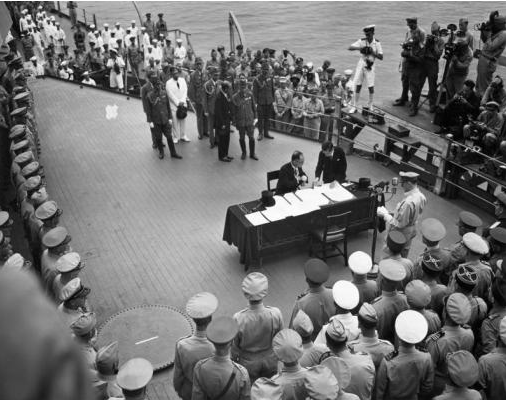
Paris Peace Conference, 1919
The First World War (which was known as "the Great War," because it was assumed to be 'the war to end all wars') ended in an armistice or truce, and not a surrender. Afterwards, the representatives of 29 countries met in Pais and hammered out a number of treaties (the "Paris Peace Treaties") that imposed conditions on the defeated nations, including crippling war reparations, that virtually assured that the peace wouldn't last. It didn't.

During the course of the ensuing Second Word War, the leaders of the main Allied Powers met and decided their would only be one condition for ending the war, that being the "unconditional surrender" of the Axis Powers (principally Germany, Italy and Japan).

Japan's "Unconditional Surrender," 1945
It's been said, that Japan, in particular, as the last combatant to surrender, faced the toughest conditions of all in implementing its "unconditional surrender," Their emperor, considered a living God by the people of Japan, had to go on the radio (in itself unheard of) and admit defeat; all of Japan's weapons were then inventoried and turned over to its former enemies; a new constitution was written for it by the Allied Powers (including a provision that it would never rearm); and those leaders that had led Japan into war (who hadn't killed themselves) were tried and executed.

And what was the result? Aid flowed into Germany and Japan as part of the Marshall Plan, and within scant years, each was amongst the richest and most productive economies in the world, and they in turn became not only functioning democracies, but trusted and crucial allies of their former enemies.

Admitting complete defeat, and the unconditional surrender of the right to manage and care for one's own life, is, of course what is necessary for one to enjoy the full promise that the 12 Steps hold out to the newcomer.

"Who cares to admit complete defeat?"
"Who cares to admit complete defeat?," we read in the opening chapter of the Twelve Steps and Twelve Traditions. An admission of complete defeat, we read, is necessary because, "We perceive that it is only through utter defeat (that we are) able to take our first steps towards liberation and strength." Like Germany and Japan, we are asked to make an unconditional surrender, in order to access the help that A.A. and its sister programs so gladly offer. ("The war is over," as my first sponsor's sponsor so often said "And the good news is . . . you lost," he always added.)

Then, if we can answer this call for an "unconditional surrender" in the affirmative, we face a number of interrelated questions that are really a subset of that first and all-important questions as to whether we are completely defeated, have "hit bottom," and have admitted that we are "powerless over alcohol" and that "our lives have become unmanageable."
" . . . (F)ew people," we read, " will sincerely try to practice the A.A. Program unless they have hit botton. For practicing A.A.'s remaining eleven Steps means the adoption of attitudes and actions that almost no alcoholic who is still drinking can dream of taking. Who wishes to be honest and tolerant? Who wants to confess his faults to another and make restitution for harm done? Who cares anything about a Higher Power, let alone meditation and prayer? Who wants to sacrifice time and energy in trying to carry A.A.'s message to the next sufferer? No, the average alcoholic, self-centered in the extreme, doesn't care for this prospect - unless he has to do these things in order to stay alive himself."
If we can answer these questions in the affirmative, then we are truly in a position to finally let go of our old ideas and attitudes (our old thoughts and ways of thinking) in order to let that "unsuspected inner resource," which we all have, guide our thoughts and our actions.  (See the Spiritual Experience appendix.)

Yet a lifetime of desperately trying to manage the unmanageable - i.e., trying to manage life - is going to be a hard habit to kick. And, so, Step Three is all about the practice of letting go of our need to act upon the first fear-driven thoughts that pop into our heads, and in relying upon the deeper God-inspired thoughts of our higher consciousness to guide our words and actions.
"It is when we try to make our will conform with God's that we begin to use it rightly," we read in Step Three of the Twelve Steps and Twelve Traditions. "To all of us, this was a most wonderful revelation. Our whole trouble had been the misuse of will power. We had tried to bombard our problems with it instead of trying to bring it into agreement with God's intention for us. To make this increasingly possible is the purpose of A.A.'s Twelve Steps, and Step Three opens the door."
The "whole purpose of A.A.'s Twelve Steps" is to get us to exercise our will in conformity with God's will? That is a powerful statement. And, if God is indeed "everything" rather than "nothing," as we read at page 53 in the 'Big Book' of Alcoholics Anonymous, this must mean that we have to bring our will into conformity with the will of the Whole, with the will of "life" itself. That's a tall order. How is it possible?

Thankfully, each of us has a conscience - and are capable of being conscious of that conscience - and, therefore, each time we are about to say something or do something (or refrain from doing or saying something) that will bring us into conflict with the will of the Whole (or the will of God), we are capable of feeling the pangs of conscience. as expressed in our emotions .

In such instances, we will feel wounded pride, greedy, angry, lustful, gluttonous, envious, or tired and slothful, to utilize the range of emotions that go along with the "seven deadly sins" that are discussed later in the Twelve and Twelve. In short, we will again begin to suffer the pangs of "anxious apartness" that arises each time the "self" (or the"ego") feels threatened and seemingly needs to express itself in action or words. And that's where the rest of the "practice" of Step Three kicks in.

At the very end of Step Three in the Twelve Steps and Twelve Traditions, we read that it is, indeed "easy to begin the practice" of Step Three," for it very much a spiritual practice which is every bit as important to our long-term recovery as is our meditation practice, or our practice of taking a daily inventory. It is through this Third Step "practice," that in each time of "emotional disturbance or indecision, we can pause, ask for silence, and in the stillness" recite the Serenity Prayer.

For it is only in the deeper, higher consciousness of the "God of our own understanding" that serenity is to be found. It is only in going to this deeper, higher consciousness, that we become able to display the "courage" to change the only "thing" that we can - that is, the level of our consciousness. And, it is only in knowing that there is within us each the lower, normal self-consciousness of the human ego, and the higher, deeper consciousness of God, that we begin to actually display "wisdom."

In short, it is in making our decisions about what to say or do (or not say or do) based on this higher, deeper God-consciousness that we begin the practice of "letting go" of our egoic, self-consciousness, and "letting (the) God" of our higher consciousness run the show.

Life is, in fact, unmanageable by our lower, egoic "selves;" and, yet, it requires no management when we are attuned in consciousness to the Higher Power of the Whole, the Ground of Being, or just simply, God. "The war is over," then. "And the good news is . . . you lost!"

Sunday, April 10, 2011

Surrender Part I: Surrendering Old Ideas

"Some of us have tried to hold onto our 
  old ideas and the result was nil until

  we
let go absolutely." ('Big Book' p. 58)
Recovery from alcoholic addiction begins with surrender - letting go of the bottle and our old ideas of how we should live our lives, admitting that we are powerless over our addiction, and that life on the grand scale (and in the minutest detail) is, in fact, inherently unmanageable. Thus, it is no coincidence that the very first concept that Bill W. discusses in the Twelve Steps and Twelve Traditions is that of surrender. "Who," he asks, "cares to admit complete defeat?."

We are told in the 'Big Book' of Alcoholics Anonymous (at page 84) that we have "ceased fighting everyone and everything - even alcohol." But is that true for us? The "fight or flight" response is perhaps a human's deepest instinctive drive, and is far more basic than even his or her sexual instincts. It represents survival or 'being' itself.

In the "How it Works" passage that is used to open so many meetings, we hear time and again that "some of us . . . tried to hold onto our old ideas," in fact, "and the result was nil until we let go (of those old ideas) absolutely." Nil, nada, nothing! Nothing changes until we become willing to try and let go of old ideas - all of them - without reservation, and that is a tall order.

But nobody said that complete surrender would be easy, nor did anyone say that we would ever be rid of our old thoughts and thought patterns completely. Rather, we try and rid ourselves of the old ideas and thought patterns instead of holding on to them.

Our "ambition," which is discussed in the closing paragraphs of Step 12 in the Twelve Steps and Twelve Traditions, is to attain and maintain a conscious contact with the God of our own understanding in order that the "(i)deas, emotions and attitudes" which were once the "guiding forces" of our lives can be "cast aside" in favour of "new motivations and conceptions." ('Big Book,' page 27.) To establish such a 'conscious' contact we must clear our mind of that which already fills our 'consciousness,' i.e., our "old ideas."

But just how do we surrender our old ideas? In order to "practice" Step Three, as it is set out in the Twelve Steps and Twelve Traditions, we are told that in all times of emotional disturbance and indecision, we can simply "pause, ask for quiet, and in the stillness" recite and contemplate the words of the Serenity Prayer. Yet, while this is critical for times of great turmoil and challenges, how do we practice letting go of old ideas in the mundane moment-to-moment affairs of our daily lives? This is a more subtle question, yet the answer may, in fact, be more crucial for our attaining true peace of mind and the sanity necessary to establish and maintain permanent sobriety and a contented, purposeful life.

In their subtler aspects, Steps One through Step Three are all about responding to life on a different plane of thought than we are used to rather than reacting to life as it is thrown at us. To do this, we need to develop the capacity (through AA's process of interwoven "self-examination, meditation and prayer") to refrain from all actions, at least for a moment, in order to realize that the thoughts coursing through our minds are not 'who' we really are, and that they are definitely not our allies in trying to bend life to how we think we want it to go.

We need to surrender to the facts (i) that  life is inherently unmanageable by any one individual, (ii) that it evolves quite well enough without our grasping for control over it,  and (iii) that we are not our thoughts themselves, but rather the quiet, simple observer of those thoughts. If one is able to surrender one's thoughts and his or her identification with them, one then becomes capable of making peace with both the world,  and with one's true 'Self' which lies beyond the false duality which is mentally manufactured by the small 'self' of the human ego.

REMEMBER: We are not here to bend the world to our own narrow will. Rather we must demonstrate a deep and abiding faith in the infallible rightness of the course of events.

Thursday, April 7, 2011

Courage: The Ability to Continue in Spite of Fear

"And acceptance is the answer to all my problems today. When I am disturbed, it is because I find some person, place, thing or situation - some fact of my life - unacceptable to me, and I can find no serenity until I accept that person, place, thing or situation as being exactly the way it is supposed to be at this moment. Nothing absolutely nothing happens in God's world by mistake. Until I could accept my alcoholism, I could not stay sober; unless I accept life completely on life's terms I cannot be happy. I need to concentrate not so much on what needs to be changed in the world as on what needs to be changed in me and in my attitudes."
("Acceptance Was the Answer," Alcoholics Anonymous, page 417)

* * * * * * * * * * * * *

Of the three attributes that we ask for in the Serenity Prayer - serenity, courage and wisdom - it seems to be courage in the face of our life circumstances, with their messiness, emotional challenges and their sheer, fundamental unmanageability, that is often the most difficult for the alcoholic addict to obtain.

Why this is so, seems to be (a) that courage is almost wholly an internal matter, (b) that sometimes exercising courage goes against our most basic instincts, and (c) courage often calls for us to do or say (or not do or say) something that flies in the face of the life lessons we have learned.

The Japanese have a saying which seems to have universal application: "The nail that sticks up gets hammered down." Oftentimes it is much easier to go along with the crowd, or do what "other people" would do in the same circumstances, but for the alcoholic anonymous trying to live his or her life on a different spiritual plane, such actions may prove fatal.

How many alcoholics have started their last binge because they did not want to stand out as the only person not having a drink at a wedding or a cocktail party? Being "convinced" we are alcoholic addicts requires that we give up the "ideas. emotions and attitudes that were the guiding forces" of our lives, and to adopt wholly new "conceptions and motives" for living our lives.
[Alcoholics Anonymous, p. 27.]


One of the more powerful stories in the back of the 'Big Book' of Alcoholics Anonymous is that of a Vietnam vet and pilot facing a prison term for flying a commercial airliner while under the influence. In the story "Grounded," he writes:
"From somewhere back in high school I remembered a poem that says something like, 'Cowards die a thousand deaths, a brave man only once,' and I wanted to do what had to be done. I was terrified of walking into prison but told my children that I could not come out the back door until I walked through the front. I remembered that courage was not the absence of fear; it was the ability to continue in spite of it."
[Emphasis added.]
 "Courage" - from "cour," the Old French word for 'heart' - means that we have to shift our thinking and identification from our ordinary level of self-consciousness (or "ego" consciousness) to a deeper and higher level of our consciousness and being, and then to base our actions (or refrain from taking action) upon what that higher, God-consciousness dictates.

This, of course, may be the most difficult mental task, especially under unusual and unexpected, emotionally-charged situations. It is a test of both the decision we have made in Step Three to "turn our will and our lives over" to the care of a God we do not and cannot fully understand, and of our entire willingness in Step Six to have our character defects removed. For most of us, we continue to "fall back" upon our old ideas and actions in many of such instances.

In such cases, it is perhaps helpful to re-examine what our Serenity Prayer means, and what it is we are asking for, or seeking, in the most challenging situations we face in our lives.

To me, God, or the deeper level of God-consciousness we are all capable of attaining, is the "serenity" we ask for. The "wisdom" I seek is a recognition that there are at least two distinct levels of human consciousness: the "ego" or "Self," and the higher "Self" or "soul" of a man or woman. And the "courage" I need is to let go of the thoughts and thinking patterns of ego-consciousness in order that the thoughts of God-consciousness may emerge from where they have been obscured.

(Remember that " deep down within every man, woman and child is the fundamental idea of God," although "(i)t maybe obscured by calamity, pomp and worship of other things, but in some forth or other it is there.")
[Alcoholics Anonymous, page 55.]


To face prison, our pilot had to let go of his fears and face the circumstances that caused his fears. That is the very essence of courage. But it does not come easily. "All our instincts" may cry out against what we know we need to do or say in a frightening situation; yet, even in such circumstances it remains a truism that conforming our will to God's will (doing or saying, or not doing or not saying, what is indicated by our higher consciousness) is the better way, and will ultimately result in a better set of circumstances for us, and for everyone else.

"God is either everything or else He is nothing," we read at page 53 of the 'Big Book.' "God either is, or He isn't. What (is) our choice to be?"

Taking the view that God is, in fact, everything, there is then nothing we cannot face, despite all our instinctive drives to avoid our life circumstances. And that is the 'heart' of the 'courage' we are granted through the practical application of the Serenity Prayer. It is what brings us back to the serenity of God.

Yet we are challenged - throughout our recovery - to practice attaining to this higher God-consciousness by disciplining our smaller "selves" through the interwoven practices of "self-examination meditation and prayer." Without such discipline and practice, we may not be able to summon the "courage" to face, and face down, the things we will surely have to.
[Twelve Steps and Twelve Traditions, page 98.]

Thursday, March 31, 2011

Is it Really JUST the 'Big Book' We Need?

One trend I do not remember from when I sobered up 20-odd years ago was the fanaticism over the idea - or the very idea itself - that the 'Big Book' of Alcoholism Anonymous is the "only" text that should be used in sobering up, or in taking a newcomer through the 12 Steps. It seems to me that this somewhat militant stance - directed particularly towards the Twelve Steps and Twelve Traditions in my local area in Southern Ontario, Canada - is at once intellectually dishonest, close-minded, and demonstrates an unwillingness to grow beyond the initial working of the Steps as outlined in the 'Big Book,' which is, admittedly, our "basic text."

Without the Twelve Steps and Twelve Tradition, we would not have the all-important Serenity Prayer, nor would we have the 11th Step Prayer. Additionally, the lessons on daily living drawn from essays on how to "practice" Steps 3, 6, 7, and 11 are vital tools in our "spiritual tool-kit."

This does not mean that I don't take sponsees through the Steps as outlined in the 'Big Book,' or don't strongly recommend to other sponsors that this is what they should do, but I (and many, many others) have found the  Twelve Steps and Twelve Traditions to be absolutely essential in attaining, maintaining and improving a conscious contact with the God of our understanding - particularly in tough times.

In times of great emotional stress, sometimes the only thing I have to rely on is the Serenity Prayer. In the 'Big Book' of Alcoholics Anonymous, "taking" Step Three is simply described as reciting - some insist on one's knees - the Third Step prayer set out on page 63. Yet, while one snippet from the Third Step Prayer ("relieve me of the bondage of self") is perhaps my most frequent prayer, having once recited that prayer is not sufficient to practice Step 3 months, or years, later. And this is particularly so in times of grave emotional distress. At such times, even having recited the Third Step Prayer in the morning may not suffice.

This is why Bill W. concludes his essay on "practicing" the Third Step in the Twelve Steps and Twelve Traditions by recommending that we take the following actions in the times of great difficulties we are bound to face:
'In all times of emotional disturbance or indecision, we can pause, ask for quiet, and in the stillness simply say: "God grant me the serenity to accept the things I cannot change, courage to change the things I can, and wisdom to know the difference. Thy will, not mine, be done."'
 Just as we do not "pause, ask for quiet, and in the stillness" pray just once; neither is what "separates the men from the boys" (according to Bill's "spiritual sponsor," Father Ed Dowling"), the hour we spend at home after sharing our Fifth Step reviewing our progress so far and seeing if we've scrimped anywhere, as Step Six is outlined in the 'Big Book.'

We need to consistently and logically interrelate and weave together the continual process of "self-examination, meditation and prayer" if we are to have "an unshakeable foundation," as it says in Step 11 of the Twelve Steps and Twelve Traditions. To do this, the more help the better I say; and it is likely this attitude that prompted A.A.'s commissioning Bill to write down in essay form his thoughts and experiences with the Steps and Traditions in the first place.

We cannot have too much insight into the nature of, and spiritual solution to, our basic problem - ego-centricity - and there are any number of valuable references outside of the 'Big Book' that are of assistance to the newcomer and old-timer alike.

Indeed, in the "Co-Founders of Alcoholics Anonymous" pamphlet, Dr. Bob states quite plainly that he 'cultivated' the habit of reading an average of one hour a day from a variety of sources over the 15 years of his sobriety. (The key concept here being the variety of sources, rather than the amount of time spent reading.)

In its group consciouness, Alcoholics Anonymous saw fit to publish nine separate books and a wide variety of pamphlets, as well as setting up the "Grapevine" and The AA Grapevine Inc., to publish what the General Service Conference recognized as "the international journal of Alcoholics Anonymous," and a treasure trove of other material helpful to the recovering alcoholic addict.

To say that we should narrowly restrict our study to just the 'Big Book' and to shun at all costs the Twelve Steps and Twelve Traditions is precisely the attitude that Doctor Bob warned of in his last major talk (published in the "Co-founders" pamphlet), when he observed:
"We are all inclined to have pretty closed minds, pretty tightly closed. That's one reason why some people find our spiritual teaching difficult. They don't want to find out too much about it, for various personal reasons . . . "